Drink less, without the lecture.

Soberbara is a judgement-free drink tracker with a very relaxed capybara. Log your day in a few seconds, then keep a weekly budget or count your dry days.

Soberbara app screen: Drink less, without the lecture.

How Soberbara works

You log one number a day. Soberbara builds the rest from it.

Open the app, set how many drinks you had and save. That's it. Add a short note if you want to remember why a day went the way it did.
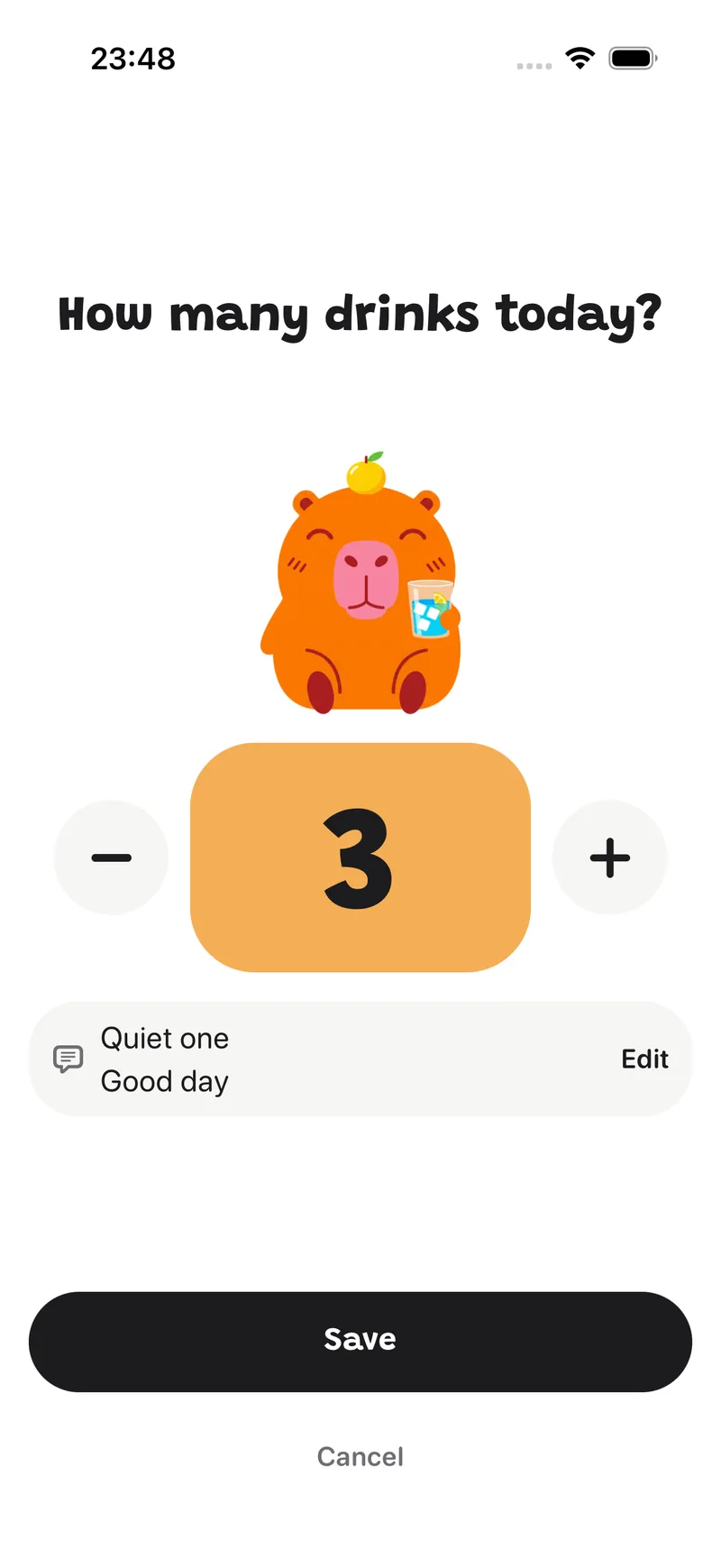
Soberbara app screen: Log your day in a few seconds

Log your day in a few seconds

  • One-tap dry days from widgets, reminders and Siri
  • Notes with quick starters like "Work drinks" or "Felt proud"
  • Log or fix any past day from the calendar
  • Drinks are counted exactly as you log them
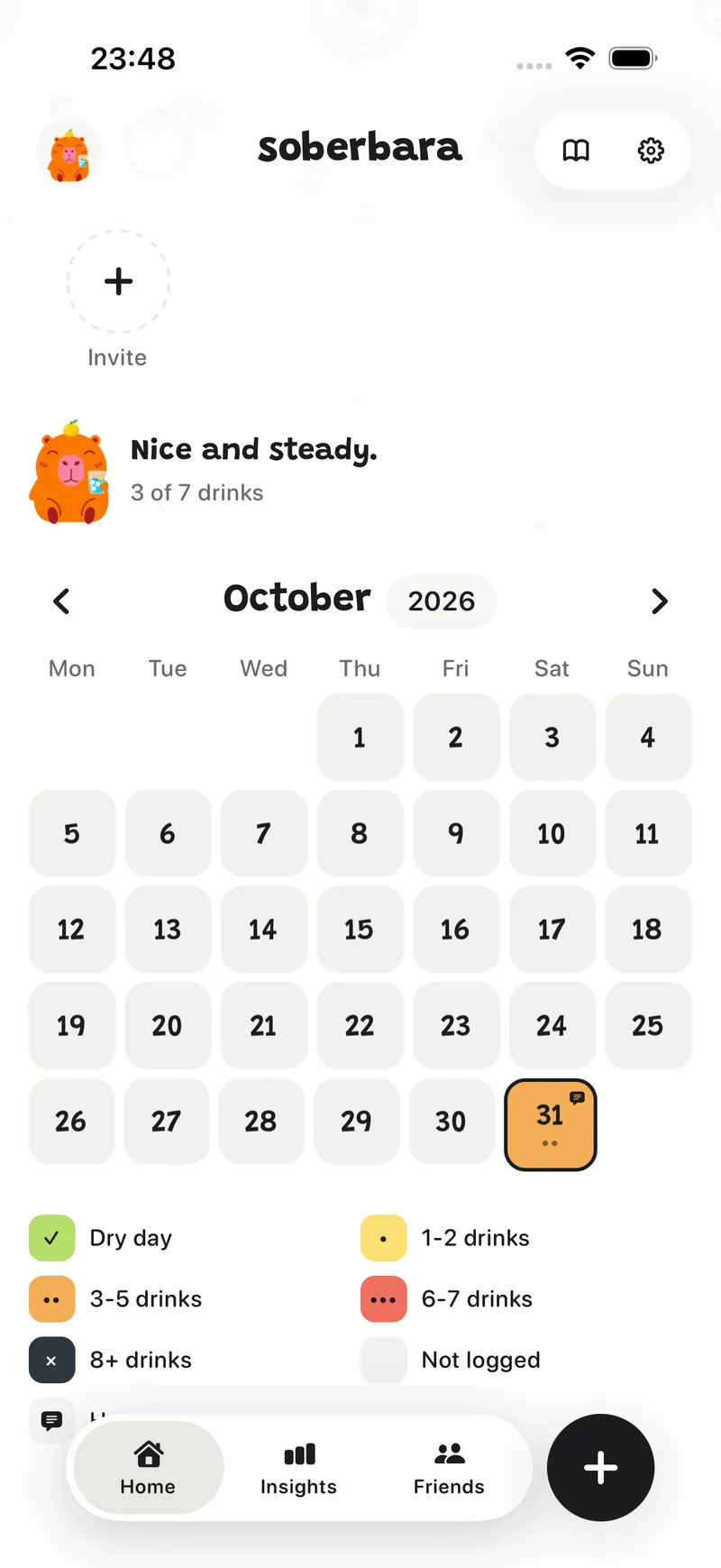
Your home screen shows your dry day streak, your best run and how your week is going against your budget. One big week doesn't reset the weeks you were on track.

Soberbara app screen: Streaks that forgive a bad night

Streaks that forgive a bad night

  • Weekly drink budget or dry-days goal
  • Weeks on track and dry weeks counted
  • Month and year calendar views
  • Home Screen and Lock Screen widgets

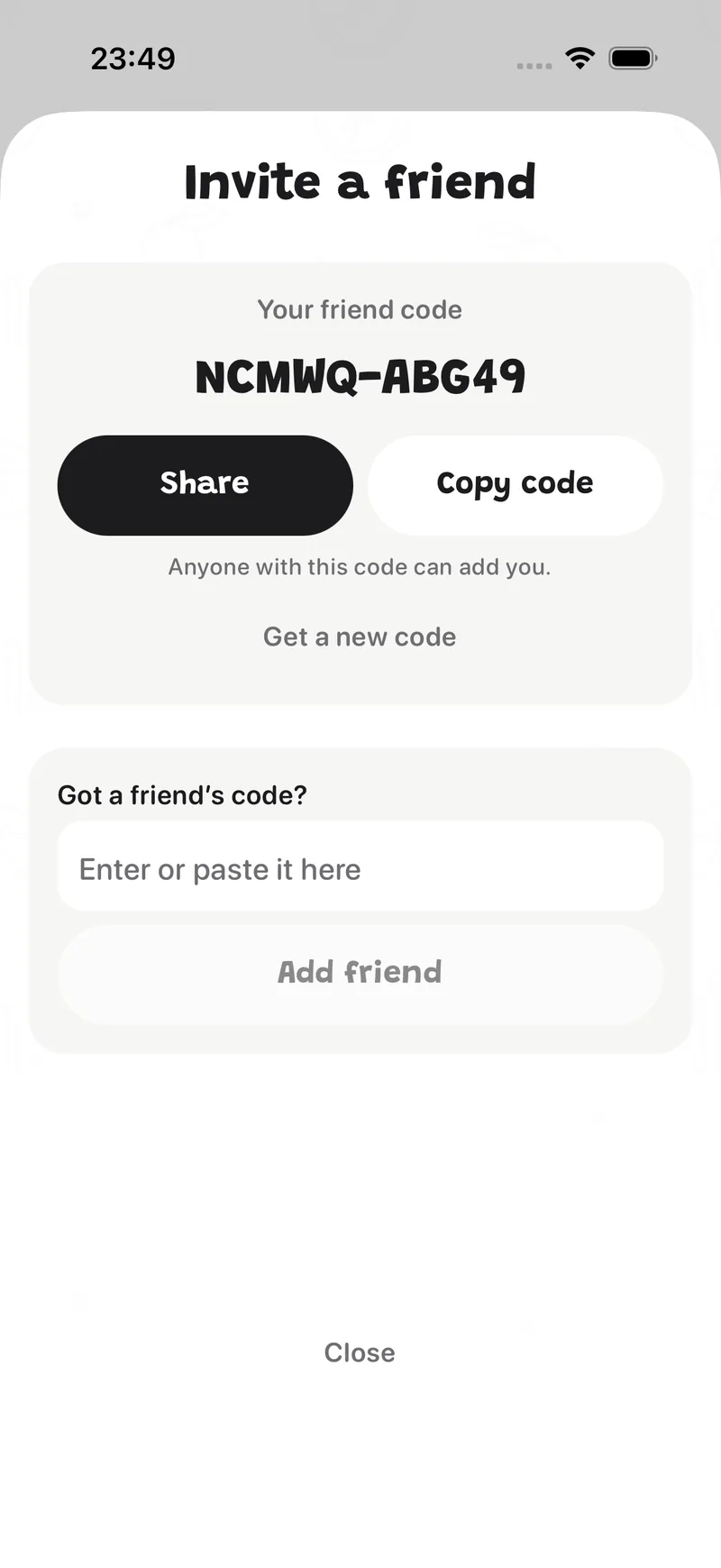
Add friends with a code or an invite link. If you choose to share, they see your goal score, logging streak and whether you've logged today. Your drinks, notes and spending always stay private.

Soberbara app screen: Friends see your progress, not your drinks

Friends see your progress, not your drinks

  • Leaderboard ranked by days on goal, never by drinks
  • Send stickers like "Proud of you" and "High five"
  • Share progress or keep it private, any time
  • Block and report tools built in

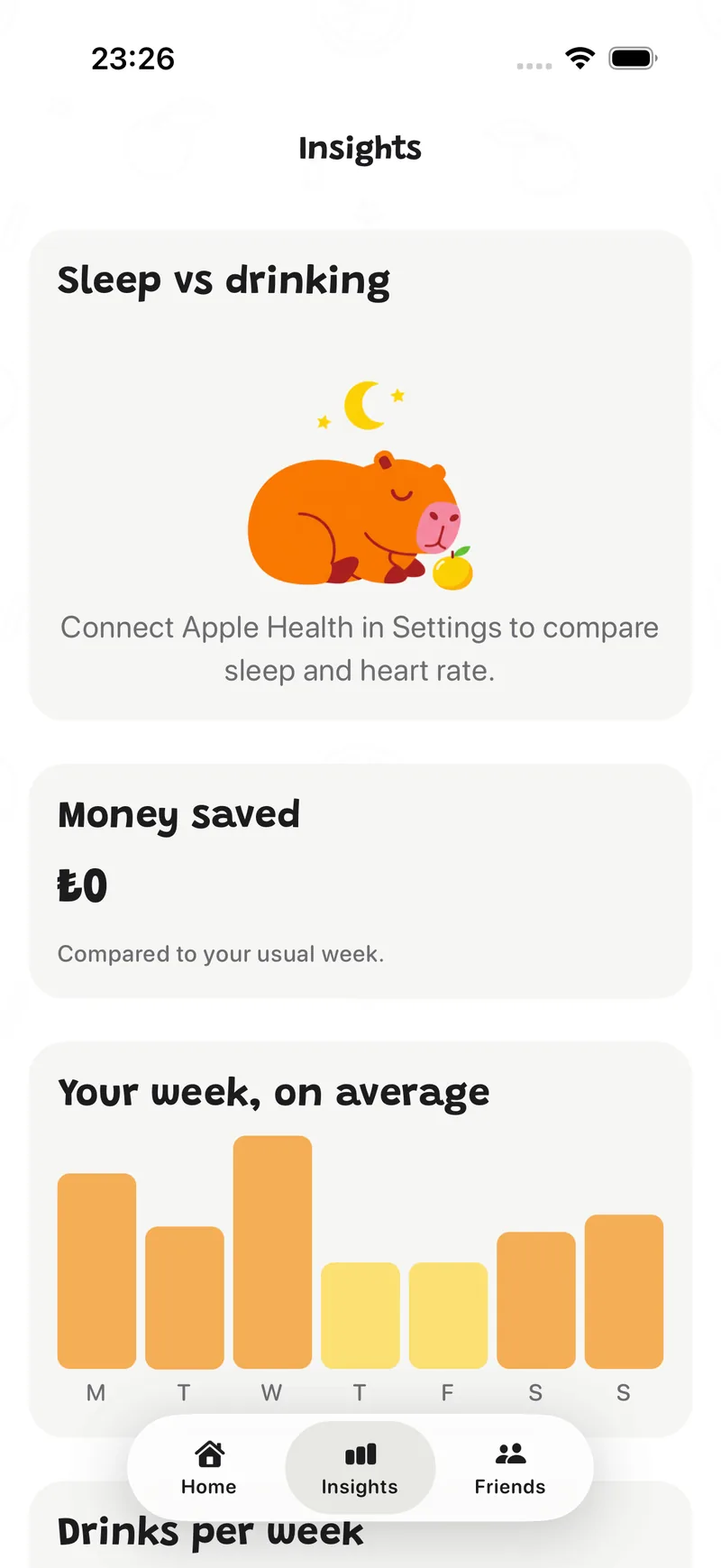
Soberbara Plus turns your days into insights: drinks per week, which weekdays do the heavy lifting, money kept compared with your usual week, and how your sleep and resting heart rate compare on dry days.

Soberbara app screen: Insights from your own days

Insights from your own days

  • Weekly trends and weekday rhythm
  • Money saved, based on your own usual spend
  • Sleep and resting heart rate from Apple Health
  • A yearly recap you can share

Practical tips, whatever your goal Ideas for drinking less, handling social plans and sleeping better. Use what helps.

Plan your dry days in advance

Decide on Sunday which days this week will be alcohol-free. A plan made with a clear head is much easier to keep than a choice made at 7pm on a hard day.

Start later, not just smaller

Having your first drink an hour later, or only after you've eaten, quietly trims an evening without feeling like a sacrifice. The NHS suggests eating before your first drink too.

Have a default swap ready

Keep something you genuinely like in the fridge: sparkling water with lime, an alcohol-free beer, a good tea. The habit is often the glass in your hand, not what is in it.

Count, don't judge

Write the number down every day, including the zeros. Honest data beats good intentions, and the patterns you spot are yours to act on.

Easy to keep doing

Tracking only helps if you stick with it, so logging takes seconds and one bad week doesn't wipe your progress.

Soberbara app screen: Easy to keep doing

One subscription for the whole app Soberbara is subscription-only: Soberbara Plus covers everything, from your first log to insights, the Apple Watch app and your yearly recap.

Soberbara Plus

Everything in the app

  • Daily logging, with notes
  • One-tap dry days from widgets, reminders and Siri
  • Weekly budget or dry-days goal
  • Streaks, calendar and year view
  • Private journal
  • Friends, leaderboard and stickers
  • Saves your drinks to Apple Health
  • Face ID lock
  • No ads, ever
  • Drinks per week and weekday patterns
  • Money saved compared with your usual week
  • Sleep and resting heart rate on dry vs drinking days
  • Apple Watch app
  • Your yearly recap
  • Yearly or monthly plan
Get Soberbara Plus

Soberbara needs a Soberbara Plus subscription, yearly or monthly. Prices vary by country and are shown in the App Store before you subscribe. Both the monthly and the yearly plan start with a 3-day free trial for eligible new subscribers, then renew at the price shown in the App Store. Subscriptions renew automatically unless cancelled at least 24 hours before the end of the period, and you can manage them in your App Store settings.

Frequently asked questions

  • Soberbara is a calm drink tracker for iPhone. You log how many drinks you had each day, set a goal to drink less or to quit, and watch your streaks, calendar and progress build up. There are no ads and no lectures.

  • No. Soberbara is subscription-only: daily logging, widgets, reminders, Siri, streaks, the weekly budget, calendar, journal, friends, Apple Health, insights, the Apple Watch app and your yearly recap all come with Soberbara Plus, a yearly or monthly subscription. Both the monthly and the yearly plan start with a 3-day free trial for eligible new subscribers, then renew at the price shown in the App Store.

  • Soberbara counts drinks exactly as you log them. It doesn't convert them into units, grams or calories, so you can count in whatever way makes sense to you. If you connect Apple Health, each drink is saved there as one standard drink. A standard drink isn't the same everywhere: about 14 g of alcohol in the US and 8 g in a UK unit.

  • Absolutely. Pick "Drink less" during setup and Soberbara keeps a weekly budget instead of counting dry-day streaks. You can switch between drinking less and quitting at any time.

  • Nothing dramatic. Your budget is a guide, not a rule. A week over budget doesn't erase the weeks you were on track, and a slip never undoes the dry days before it. Next week starts clean.

  • Only what you choose to share: your goal score, your logging streak and whether you've logged today. Friends never see how many drinks you had, your notes or your spending. You can turn sharing off at any time, and remove or block anyone.

  • Every account has a friend code and an invite link. Share either one with someone you trust, and once they accept you'll appear on each other's Friends tab. You can get a new code whenever you like, which stops old codes and links working.

  • Yes. Soberbara can save your drinks to Apple Health, and it can read your sleep and resting heart rate to compare your averages on dry days and drinking days. Your Health data stays on your iPhone.

  • No. Soberbara shows patterns in your own days, like sleeping more on dry days, but it can't prove what caused them and it never estimates blood alcohol, health risk or whether you're fit to drive. If you're worried about your drinking, please talk to a doctor.

  • Yes. The Apple Watch app lets you log drinks or a dry day from your wrist and see how your week is going. It's included with Soberbara Plus.

  • Yes. Home Screen and Lock Screen widgets show your streak or weekly budget, and you can log a dry day in one tap. You can also log with Siri or Shortcuts, for example by saying "Log a dry day in Soberbara".

  • Soberbara has no ads. Your days are stored privately in your account, your journal notes are visible only to you, you can lock the app with Face ID, and content is hidden in the app switcher. You can delete your account and all your days at any time from Settings.

  • Yes. Choose the quit goal, log each dry day with a tap and invite a friend to do the month with you. Soberbara isn't connected to any campaign or charity, so it works for any challenge you set yourself, any month of the year.

  • Soberbara Plus comes as a yearly or monthly subscription. Prices vary by country and are always shown in the App Store before you subscribe. Both plans start with a 3-day free trial for eligible new subscribers.

  • No. Soberbara is a tracking tool, not a medical service, and it can't treat alcohol use disorder. If you're dependent on alcohol, stopping suddenly can be dangerous, so please speak to a doctor first. In the UK you can call Drinkline on 0300 123 1110, and in the US the SAMHSA National Helpline on 1-800-662-4357.

  • Soberbara is available in 16 languages: English, German, Spanish, French, Italian, Portuguese (Brazil), Japanese, Korean, Simplified Chinese, Turkish, Dutch, Polish, Russian, Indonesian, Vietnamese and Thai.

Still have a question? Contact

A calm, practical guide to drinking less

Most people who want to drink less aren't in crisis. They've noticed that the after-work drink has become two, that Sunday mornings feel heavier than they used to, or that they'd like more say in the matter. This guide is for that moment: approaches that tend to work, backed by guidance from health organisations, with no rules and no lecture.

Why cutting back is worth it, even a little

You don't need to quit to feel a difference. Health bodies are consistent on one point: less is better than more. The CDC says drinking less is better for your health than drinking more, and the World Health Organization points out that alcohol is a Group 1 carcinogen linked to at least seven types of cancer.

That can sound heavy, so here's the lighter version: every drink you skip is one your body doesn't have to deal with. The NHS lists short-term gains people often notice when they cut down, like feeling better in the mornings, having more energy and saving money, and longer-term ones like lower blood pressure and better mood, memory and sleep.

You don't have to be perfect. A week with two fewer drinks than usual is a better week.

Start by knowing your real number

Most of us underestimate what we drink, not because we're hiding anything, but because drinks blur together. A top-up here, a bigger glass there. The single most useful thing you can do at the start is simply count, honestly, for two or three weeks, without trying to change anything yet.

A few tips for an honest baseline:

  • Log every day, including the zeros. Dry days are data too, and they're often more common than you think.
  • Log the same evening or the next morning. Memory gets fuzzy fast.
  • Pick one way of counting and stick to it. You can count each drink as one, or you can work in units or standard drinks. What matters most is consistency.

If you want to understand strength properly, the NHS units guide is a great reference: a standard 175 ml glass of 12% wine is 2.1 units and a pint of 5.2% beer is 3 units. In the US, NIAAA defines a standard drink as about 14 grams of pure alcohol. Our guide to alcohol units walks through the common drinks.

Soberbara keeps this simple on purpose: you log the number of drinks you had, and that number is never converted or second-guessed. Once you have a few weeks of honest data, the next steps get much easier.

Choose a goal that fits your life

There are two broad paths, and both are valid.

Drinking less. You keep alcohol in your life but on your terms. This usually means a weekly limit and a few planned dry days. For reference, UK guidance is to drink no more than 14 units a week on a regular basis, spread over three or more days, with several drink-free days each week, according to the NHS.

Stopping, for a while or for good. Some people find moderation more tiring than not drinking at all, because every evening becomes a negotiation. For them, a clear "not drinking" is simpler. A month off, like Dry January, is a common way to try it.

If you're unsure, NIAAA's Rethinking Drinking suggests quitting is the stronger choice if you've tried to cut down and couldn't stick to your limits, if you have a health condition alcohol makes worse, take medication that interacts with alcohol, or are or might be pregnant. We go deeper on this in moderation vs sobriety.

Whichever you pick, write it down, and remember you can change it. Goals are tools, not vows.

Set a weekly limit you'll actually keep

A weekly limit works better than a daily one for most people, because life isn't evenly spread. A birthday on Saturday shouldn't mean you've failed on Saturday.

To set one:

  1. Take your baseline. If you usually have 15 drinks a week, a limit of 5 is likely to collapse by Friday.
  2. Aim for a meaningful but believable cut. Many people start by dropping a few drinks a week, then lowering the limit again once it feels normal.
  3. Decide your dry days first. Then spread your budget over the remaining days.
  4. Review weekly, not daily. Look at the whole week on Sunday and adjust.

The most important part is how you treat a week that goes over. If one big night makes you think "well, that's this week ruined", the limit is working against you. That's why Soberbara treats your budget as a budget, not a rule: an over week doesn't erase the run of weeks you've been on track. More on this in our guide to setting a weekly drink limit.

Find your triggers and plan around them

Most drinking is habit, not decision. Certain times, places, people and feelings reliably lead to a drink. Once you can name them, you can plan for them.

Common triggers include:

  • The end of the workday. The drink marks the switch from work to home.
  • Stress or a hard conversation. Alcohol becomes a quick way to take the edge off.
  • Boredom. A quiet evening with nothing planned.
  • Certain friends or places. The pub quiz, the Friday group chat, the barbecue.
  • Celebrations. Good news can trigger a drink as reliably as bad news.

A simple way to spot yours is to add a quick note when you log a day: "work drinks", "stressful day", "night out". After a few weeks, patterns jump out. Then you can build a replacement for each one: a walk or a shower to mark the end of work, a call with a friend for stress, a plan for quiet evenings.

The NHS suggests finding other ways to handle boredom or stress, like exercise or a hobby. The replacement doesn't have to be impressive. It just has to be ready.

Make the swap easy

Alcohol-free drinks have come a long way, and they can be a genuinely useful tool. The ritual of opening something cold at the end of the day is often what you're really after, and an alcohol-free beer, a sharp tonic with lots of ice or a good kombucha can fill that slot.

It helps to know what the labels mean. In the UK, Alcohol Change UK explains that "alcohol-free" means no more than 0.05% alcohol, while "low alcohol" can be up to 1.2%. A pint of 0.5% beer contains 0.3 units. If you've been advised to avoid alcohol completely, look for drinks labelled 0.0%.

A few practical ideas:

  • Stock the fridge before the week starts, so the easy choice is already there at 6pm.
  • Use a nice glass. It sounds small, but it makes the swap feel like a treat rather than a substitute.
  • Alternate on nights out. One alcoholic drink, then one alcohol-free, slows the pace without anyone noticing.

For some people, drinks that taste like alcohol can be a trigger in themselves. If that's you, skip them and go for something completely different. Our alcohol-free drinks guide covers the options.

Handle social situations with confidence

For many people, the hardest part of drinking less isn't the craving. It's the questions. "Go on, just one." "Are you pregnant?" "Since when don't you drink?"

A few things that make it easier:

  • Have a short, honest line ready. "I'm taking a break", "I'm driving" or "I sleep better without it" are complete answers.
  • Get a drink in your hand early. Most offers stop when your glass is already full.
  • Buy your own drinks. Rounds set the pace to the fastest drinker. The NHS suggests declining rounds for exactly this reason.
  • Bring an ally. One friend who knows your plan makes a whole evening easier.
  • Leave on your own terms. Decide in advance when you'll head home.

You don't owe anyone a detailed explanation. People notice much less than we fear, and the curious ones are often quietly thinking about their own drinking. Our guide on how to say no to a drink has more scripts for tricky moments.

Notice what changes: sleep, mood and money

Motivation is easier to keep when you can see results. Some of the most common changes people notice are in sleep.

Alcohol can help you fall asleep faster, but it tends to disturb the second half of the night. Drinkaware explains that alcohol reduces time in REM sleep and can have you up in the night for the toilet, which is why you may wake up less refreshed. A review published by NIAAA notes that tolerance to alcohol's sedative effect can develop within a few nights, so the "nightcap" stops helping you drop off while the disruption remains. Our article on alcohol and sleep explains more.

If you wear an Apple Watch or another tracker that writes to Apple Health, you can look at this in your own data. With Soberbara Plus, Insights compares your average sleep and next-day resting heart rate on dry days and drinking days, once you have at least three of each. It's a pattern in your own life, not a medical verdict, but seeing it can be surprisingly motivating.

Money is the other easy win. If you tell Soberbara roughly what a usual week looks like and what a drink usually costs, Plus shows what you've kept in your pocket compared with that usual week.

Get support from people you trust

Changing a habit alone is harder than it needs to be. Research on Dry January from the University of Sussex found that benefits were more likely among people who registered for the challenge online and used its support, and having others alongside you makes the whole thing feel less like a solo test of willpower.

Support doesn't have to mean telling everyone everything. It can be one friend who checks in, a partner who keeps the fridge stocked with alcohol-free options, or a small group doing the same challenge.

Soberbara's friends feature is built around that idea, with privacy at the centre. You invite people with a code or link, and if you choose to share, they see your goal score, logging streak and whether you've logged today. They never see what you drank, your notes or your spending. The leaderboard ranks friends by days on goal over the last 30 days, never by drinks, so it rewards consistency rather than comparing nights out. Sending a "Proud of you" sticker takes two seconds and means more than you'd think.

When a slip happens

It will. Everyone who changes a habit has nights that don't go to plan. What matters is what you do the next day.

  • Log it honestly. Skipping the log to avoid seeing the number is how one night becomes a lost week.
  • Look for the trigger, not the flaw. Was it a particular event, a tough day, being tired or hungry? That's useful information.
  • Get back to your plan at the next opportunity. Not next Monday. Tomorrow.
  • Keep the long view. One heavy night doesn't cancel weeks of progress.

This is why Soberbara doesn't do all-or-nothing streaks. Your weekly run survives a week over budget, and a slip doesn't undo the dry days before it. Progress is the trend, not the perfect record.

When to get more help

Tracking and good habits help many people drink less, but they aren't a substitute for medical care. Please talk to a doctor or a specialist service if you regularly drink more than you mean to, find it hard to stop once you start, need a drink in the morning, or feel shaky, sweaty, anxious or unwell when you don't drink.

That last one matters. The NHS warns that it can be very dangerous to stop drinking suddenly if you're dependent on alcohol, and advises getting medical help before you try to stop if you get withdrawal symptoms.

Free, confidential help is available:

Asking for help is a strong, sensible move, and it's never too early. For everyone else, start small, count honestly and be kind to yourself. Our guide on how to cut back on drinking is a good next read, and if January is on your mind, see our Dry January tips.

Guides for drinking less

Practical, judgement-free guides to cutting back, dry months, sleep, money and social life.

Your first log takes a few seconds.

Download Soberbara, log today's number and keep going from there. No ads, no lectures.

Download on the App Store